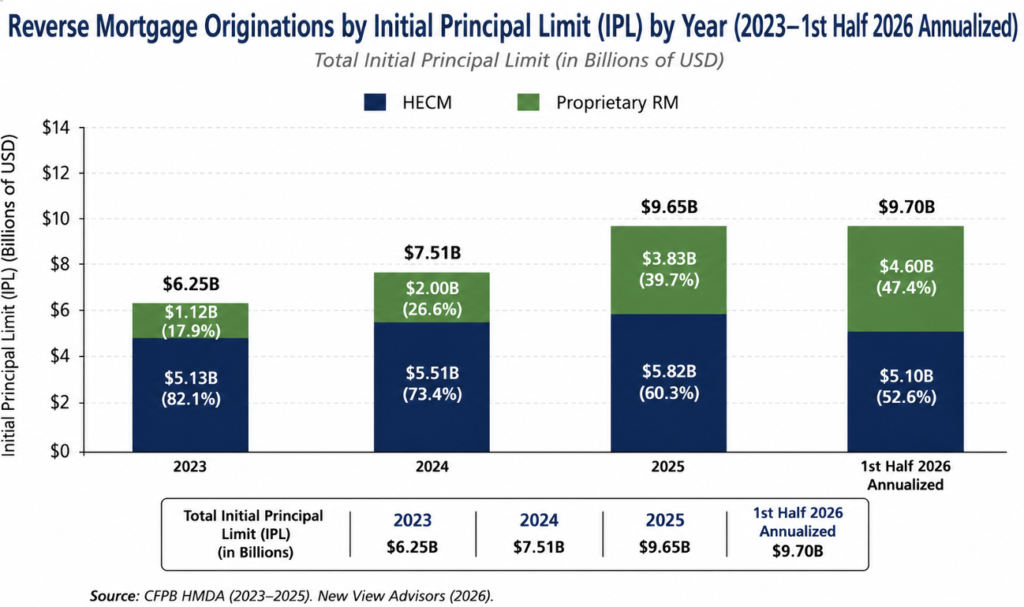
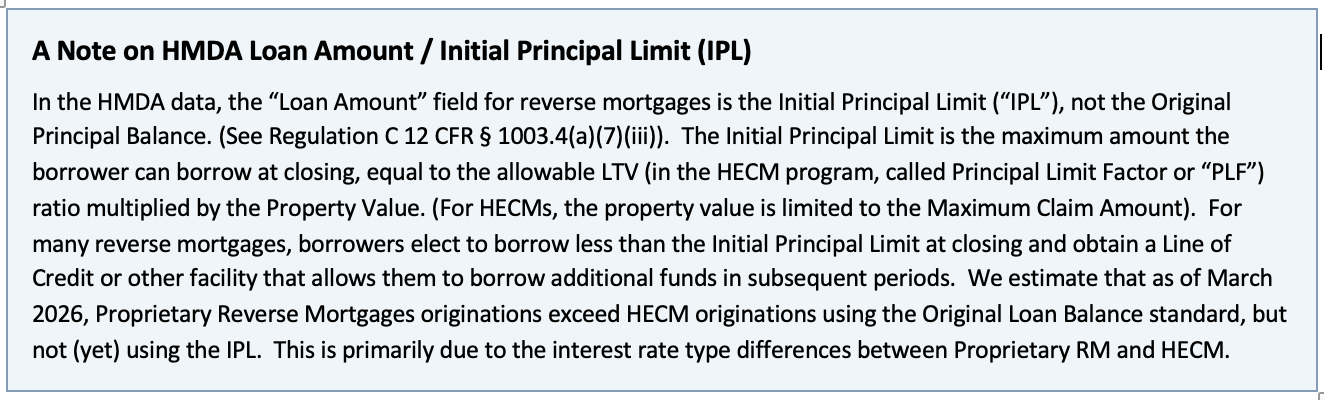
Proprietary reverse mortgages drove 28% growth in the reverse mortgage origination market last year, according to Home Mortgage Disclosure Act (“HMDA”) data released by the Consumer Financial Protection Bureau. The total Loan Amount of all reverse mortgages has grown in each of the last two years, from $6.25 billion in 2023 to $7.51 billion in 2024 and $9.65 billion in 2025, according to the HMDA data. Proprietary Reverse Mortgages are driving this growth, increasing from $1.1 billion in 2023 to $3.8 billion in 2025. That means proprietary volume increased roughly 245% in two years, versus about 54% for the entire reverse-mortgage market.
Reverse Mortgage Origination Trends
This trend continued in the first half of 2026. If we annualize our own first half numbers, HECM originations would fall back to 2023 levels this year while Proprietary volume could challenge 2022’s record proprietary volume. However, all mortgage lenders, forward and reverse, Proprietary and HECM, face a challenging interest rate environment. This may make for rough going in the second half.
In the reverse mortgage sector, HECM will almost certainly fare worse in a higher rate environment than Proprietary, as its already daunting Initial Mortgage Insurance Premium (“IMIP”) will increase as a percentage of the HECM loan amount. The IMIP is pegged to the Maximum Claim Amount (“MCA”), which is equal to the lesser of (i) underlying property value and (ii) $1,249,125. As interest rates rise, the HECM borrower gets less proceeds, but the IMIP stays at its very high level, nearly $25,000 for many borrowers with homes valued at or above the MCA limit, and well over $10,000 for most borrowers.
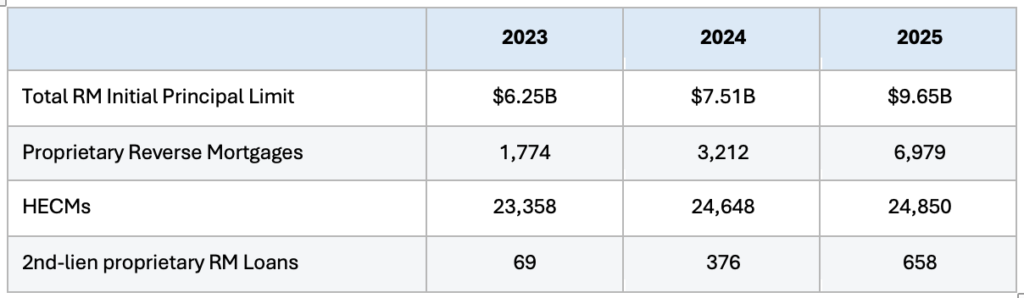
Most other mortgage lending volume estimates rely primarily on original loan balance or unit count. Looking at the HMDA unit count, Proprietary Reverse Mortgage loans grew from 1,774 loans to 3,212 loans to 6,979 loans in 2023, 2024, and 2025 respectively. Meanwhile, HECM unit volume stagnated, posting unit counts of 23,358, 24,648, and 24,850, respectively in those same years. In other words, HECM units increased only about 6% from 2023 to 2025, while proprietary units nearly quadrupled.
As mentioned above, Proprietary reverse mortgage originations peaked in 2022 during the low-interest rate period earlier this decade. Very few Proprietary Reverse Mortgages were originated from 2010 to 2017, when they were reintroduced. Prior to that period, Lehman Brothers had a successful Proprietary reverse mortgage program that produced five securitizations from 1999 to 2007.
The HMDA data also shows that second-lien Proprietary Reverse Mortgage loans are an emerging but still small segment. Second-lien Proprietary RMs grew from a handful of loans in 2022 to 69 loans in 2023, 376 in 2024, and 658 loans with a total IPL of $148 million in 2025.
New View Advisors compiled this data from publicly available CFPB/FFIEC/HMDA and Ginnie Mae data as well as private sources.